

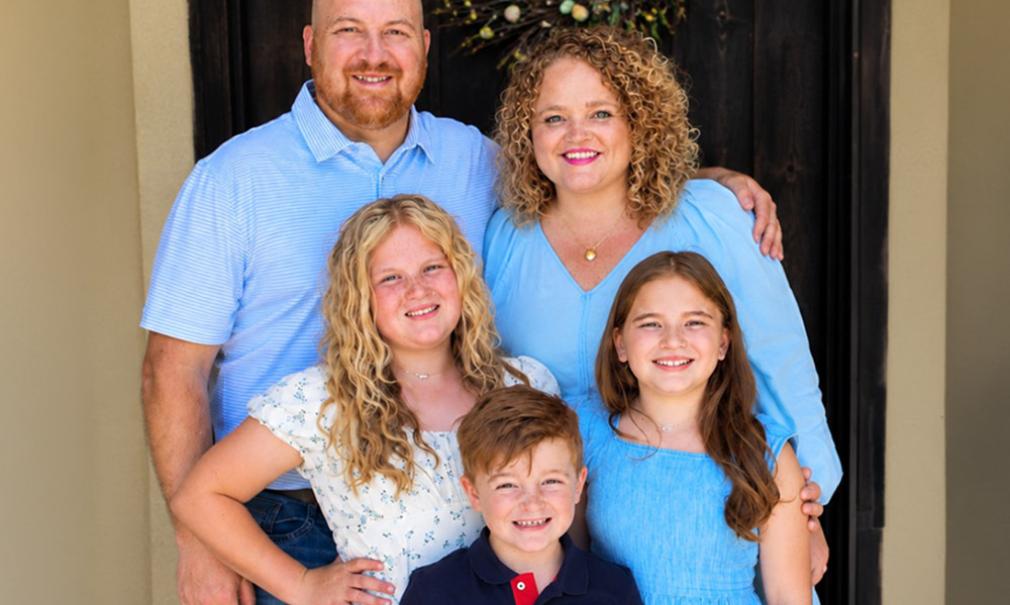
Ground-breaking RP Impella® Application Saves Husband, Father of Three
By Saint Francis Health System Staff
When Kenny Fisher celebrates his 40th birthday in October, it will be an extra special occasion for him, his family and friends.
“Anyone who tells me there’s no God, I say ‘you’re out of your mind’,” Kenny says. “I defied the odds my whole life, God has a lot to do with it, I think attitude has a lot to do with it, too.”
Kenny was born with a rare congenital heart defect called tricuspid atresia—the heart’s tricuspid valve doesn’t form properly (or at all), blocking blood flow from the right atrium to the right ventricle, causing the right ventricle to either not grow or be so small that it is not functional.
By age five, Kenny had undergone six open-heart surgeries to achieve what is known as Fontan physiology.
“Instead of having two lower pumping chambers, Kenny has one,” says Pradyumna Agasthi, MD. “Fontan physiology is creating passive blood flow from upper and lower body veins to fill the pulmonary arteries.”
Kenny’s Fontan was among the first successful procedures of this type in Oklahoma. He went on to have a healthy, active childhood and young adulthood racing MX bikes and eventually launching his own machine shop.
“Kenny is the hardest-working person I know,” says his wife, Meghan. “He would work 75-hour weeks at our small business; he never got sick or napped during the day. I first knew something was wrong when he came home during lunch one day and took a nap. That was a red flag to me.”
From Routine Doctor Visit to the ICU
The family had recently had a bout of the flu, but Kenny’s symptoms weren’t improving, so in February they went to urgent care. From there, Kenny’s condition rapidly got worse.
“His oxygen saturation was way too low, so they sent us to the ER, then eventually to Ascension St. John where his cardiologist is. Within 48 hours he was admitted to the ICU and intubated,” Meghan says. “Our team there was fantastic, they told us upfront Kenny needed an adult congenital heart specialist.”
He was in refractory cardiogenic shock with multiorgan failure (requiring intubation) and continuous dialysis. His condition kept deteriorating.
After a series of calls and coordination between St. John and other area hospitals, Dr. Agasthi—recently hired at Saint Francis Heart and Vascular Institute—took over Kenny’s case.
“By the time he arrived, Kenny had respiratory failure, kidney failure and cardiogenic shock. We struggled to get fluid out of him because of low blood pressure. He required multiple IV medications (called inotropes) to keep his blood pressure up. Normally, at this point, if a patient doesn’t improve, they either get a multi-organ transplant or die.”
— Dr. Agasthi
Trying Something New
Timely transplant was not an option for Kenny, so Dr. Agasthi and the HVI team needed another option, fast. They turned to a device called an RP Impella®, a temporary pump that allows the heart to rest and recover while delivering enough blood and oxygen to the rest of the body.
The heart pump was made for people with right ventricle failure as it helps pump blood from the inferior venacava (IVC) – a large vein that carries deoxygenated blood from the legs and all organs below the diaphragm. In Kenny’s case, he does not have a right ventricle, however he still needs more blood to flow from his IVC to his lung arteries (pulmonary arteries).
“My mentor at Mayo Clinic and I had modeled a failing Fontan physiology in the animal lab with pigs’ hearts, and the Impella worked perfectly. That’s why I was so confident it would work for Kenny,” says Dr. Agasthi.
For Meghan, that confidence made all the difference.
“When I first met Dr. Agasthi, he said ‘I know how [Kenny’s] heart works.’ He had a plan, which I knew was not a ‘normal’ use for the Impella, but I had confidence in what he was telling me. Dr. Agasthi was so calm and straightforward, he had backups if the Impella didn’t work. He was truly an answer to my prayers. I specifically prayed for a doctor with confidence; Kenny’s condition is so rare and complex. After talking to him, I realized that working with Dr. Agasthi was exactly what I asked for.”
— Meghan Fisher
Kenny improved immediately after placing the RP Impella®. He did not need any inotropes or vasopressors (medications to increase blood pressure) anymore. Dr. Agasthi and his team were able to remove 22 liters in 3 days and eventually removed the pump and had him extubated.
His kidney needed longer to recover, he needed intermittent hemodialysis for 3 weeks before his kidney started to work again.
As Meghan describes, these weeks were “up and down”. In addition to liters of fluid drained from his body, Kenny lost 50 pounds and suffered three seizures while in the hospital. Even so, his recovery defied expectations.
“I myself wasn’t expecting such a dramatic recovery but Kenny’s kidneys were working on their own after only a few days,” Dr. Agasthi says. “My expectation was that we would slowly get his numbers back in the right ranges and, once stable, would start discussing transplant options.”
At clinic follow up 2 months later, his kidney function completely normalized.
"As far as we know, Kenny is the first human being in the world with Fontan physiology in whom RP Impella® was placed to treat refractory cardiogenic shock. His recovery was spectacular, beating expectations," Dr. Agasthi says.
Moving Forward with a New Normal
Kenny might eventually still need a heart transplant in 10 -15 years , but his treatment through Saint Francis HVI has given him, Meghan and his medical team time to find the right program when he needs it.
“I’m confident he won’t need further intervention for 10 years,” says Dr. Agasthi. “Adult congenital heart disease cases like Kenny’s are challenging because they’re rare and highly complex. There’s just not a huge patient population for companies to test and bring new innovative treatment options like this. I had an in-depth conversation with the engineers who designed and built the Impella because even they didn’t think it would work for this type of case.”
Now that Kenny is out of the hospital, he says it’s an adjustment to his new normal of slowing down, but he’s as determined as ever to rebuild strength and keep his heart healthy.
“I honestly feel better than I did when I was 18. I’m a little weaker now but I’m the type of person who, if you say I can’t do something, I’ll find a way to do it. I just wanted to be home with my kids.”
— Kenny Fisher
Kenny will continue regular follow-ups with Dr. Agasthi and closely monitor his heart, kidneys, liver and oxygen saturation. He and Meghan are researching transplant programs for a time when he may eventually need one.
“I’m just so so grateful that Dr. Agasthi is here in Tulsa,” Meghan says. “It’s so amazing how everything fell into place for us at exactly the right time—it’s a big deal and we’re so thankful.”
Relevant Blogs to Read


What Everyone Should Know About Suicide Prevention: Myths, Warning Signs, and How to Help
View Story