What If You Could Get Back to Doing What You Love?

How minimally invasive heart procedures like CTO PCI restore your ability to enjoy more activities you love.
By Saint Francis Health System Staff
For one Saint Francis Heart and Vascular Institute patient, the goal was simple: he wanted to go fishing again.
Shortness of breath and chest pain had made it impossible to carry his gear or make it out to the lake. After a minimally invasive heart procedure at Saint Francis Heart and Vascular Institute (HVI), he's back on the water — carrying his own equipment, taking less medication and feeling like himself again.
That's what a Chronic Total Occlusion Percutaneous Coronary Intervention (CTO PCI) is really about: restoring a patient’s quality of life and ability to enjoy their favorite activities.
What Is a CTO PCI?
A chronic total occlusion is a complete or near-complete blockage of a coronary artery. Left untreated, it can cause persistent chest pain, shortness of breath and fatigue that significantly limits everyday activity.
Traditionally, CTO patients had two options: open heart surgery or medication alone. A CTO PCI offers a third path — a percutaneous (through the skin), minimally invasive approach that works from inside the blood vessel rather than through an open chest.
During a CTO PCI, a highly specialized HVI team guides a thin, flexible wire (catheter) through the femoral and/or radial (wrist) artery to access the blockage and work to balloon, stent and open it.
What to Expect
The process starts with a clinic visit to review the procedure and make sure it's the right fit. When the time comes for the procedure itself, patients are given minimal sedation — relaxed and calm, but aware of what's happening.
The HVI team works together in a dedicated lab with the equipment needed to do the job safely and efficiently. Overall, it usually takes between 2 and 4 hours, and patients spend a night in the hospital for observation.
One thing that surprises many patients: a CTO procedure doesn't automatically mean a stent.
The goal is first to answer the question — why does this patient need a heart cath? Sometimes the answer is a stent, sometimes it's a medication adjustment. Sometimes it's an entirely different approach.
The procedure is the starting point for finding out what's best for each individual patient.
At Saint Francis HVI, teams are experienced and work very efficiently together. In many cases, the data needed to make that determination is gathered in as little as 10 to 15 minutes, and CTO PCIs average an 80-90% success rate in the U.S.
Who Is a Candidate?
CTO procedures are performed on patients from 40 to 90 years old. Age alone is rarely the deciding factor — what matters most is the benefit each patient stands to gain.
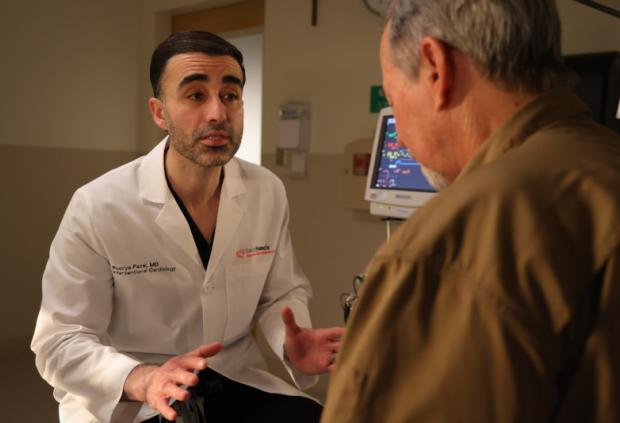
The conversation starts with one key question: what is the symptom that's limiting your life? What is something you want to do — but can't — because of chest pain, shortness of breath or fatigue?
The goal isn't just to open a blocked vessel. It's to help patients reclaim the activities and moments that matter most to them.
There’s a practical benefit to that approach, too. Patients who feel better tend to take better care of themselves — and that, over time, often means a longer life.
Is a CTO Procedure Right for You?
If you or a loved one is living with chest pain, shortness of breath or unexplained fatigue, talk to your provider about whether a CTO evaluation makes sense. At Saint Francis HVI, the goal is always the same: find the safest, most effective path to a better quality of life.
For more information about Saint Francis HVI call 918-494-8500.