

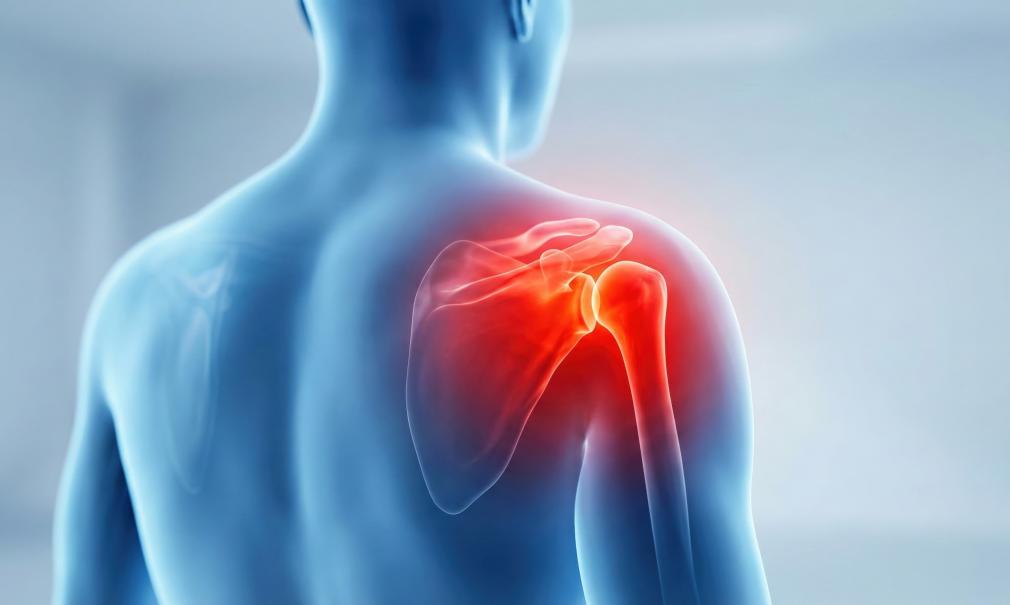
Why Does My Shoulder Hurt?
By Christopher Crane, MD
Tulsa Bone & Joint, A part of Warren Clinic
If you find yourself dealing with shoulder pain, the odds are good that you’re going to hear about the rotator cuff. The four small muscles of the rotator cuff play a big part of shoulder motion. But how can these smaller muscles, going from the shoulder blade to the upper arm, be at the center of so many shoulder problems? Even without an injury, why would your shoulder start hurting?
The Role of Muscles & Anatomy in Shoulder Pain
The shoulder is a very mobile joint. Structured like a ball and a socket, it can move in any direction, but this mobility has to be balanced with stability. The shoulder is often compared to a “golf ball on a tee” - a large ball, a small socket. The stability for these mismatched sizes comes largely from the muscles.
The shoulder blade, or scapula, sits atop the back of the rib cage, away from the shoulder joint itself. It serves as an anchor for the four rotator cuff muscles, which each attach on different sides of the shoulder.
These muscles are critical in helping us accomplish some of the more difficult shoulder motions.
For example, maybe you need to put something on a high shelf—you’re going to need to raise your arm. The deltoid muscle initiates that motion but quickly reaches its limits. That’s where the rotator cuff kicks in, supporting the ball and socket joint as it moves from by your side to high overhead.
Maybe you need to reach all the way behind you, putting your belt through a loop. The rotator cuff again makes it happen, using its position on the shoulder blade to rotate the arm.
Maybe you need to reach for your seatbelt. Or scratch your back. Or brush your hair. It’s easy to take for granted all the times we use the muscles in our rotator cuff.
That is, until it starts hurting.
The rotator cuff’s distant origin on the shoulder blade is partly why it’s a common pain point.
Feel that bony spot on the very top of your shoulder, at the end of your collarbone? That’s a joint called the AC joint, where the collarbone connects to the shoulder blade. If it gets arthritis and/or bone spurs that gradually wear on the rotator cuff tendons underneath, the pain will be hard to ignore.
Or maybe how you move your shoulder causes the arm bone to bump the edge of the shoulder blade, pinching the tendons in between, in a painful process called impingement. Impingement often causes swelling (also called bursitis) and pain with certain motions. Sometimes even just lying down on that side at night will be enough to worsen the pain of bursitis.
How Compensating Muscles Aggravate Shoulder Pain
If your rotator cuff is painful or injured, your brain subconsciously attempts to change things up: use the rotator cuff less, get other muscles to compensate.
Some of the bigger muscles along the shoulder are well-known and easy to see. The biceps, the deltoid, the trapezius, and the pectoral muscles all play important roles in shoulder motion and strength.
When the rotator cuff is painful or weak, these muscles compensate.
In practice this may look like hiking your arm upward instead of raising it, overworking the trapezius. Or, you might find your shoulder is rolled forward, putting you in a position to rely more on pectoralis and biceps muscles, and reducing the shoulder blade’s ability to help. The rotator cuff muscles get weaker, and impingement gets worse.
Eventually, these bigger muscles get tired of working double duty. You’ll feel pain and muscle spasms along the front of the shoulder, or down the side of the upper arm, or from the shoulder all the way to your neck. But the root of the problem is still back at the shoulder blade.
Training the Right Muscles for Long Term Relief
We know that strengthening the rotator cuff can reduce impingement and help pain, even in the case of partial tears.
However, those muscles need specific exercises to strengthen, and a physical therapist can monitor you to ensure you’re working the right muscles and not accidentally compensating with the “wrong” ones.
Medicines or injection treatments can help temporarily reduce the pain so you can better tolerate the exercises.
Your path to a life free of shoulder pain may involve both training and medication, and will demand patience and consistency, but the experts at Tulsa Bone & Joint, a part of Warren Clinic, are here for you.
Contact us today to schedule an appointment and attack your shoulder pain for long term, sustained relief.
Relevant Blogs to Read