
The Structural Heart program at the Heart and Vascular Institute is proud to offer excellent treatment options directed by interventional cardiologists, imaging cardiologists, and cardiothoracic surgeons.
We work for the best possible patient outcomes through both surgical and transcatheter valve replacement and repair using leading edge technology. Treatment options are approved by the FDA and covered by Medicare for eligible patients.
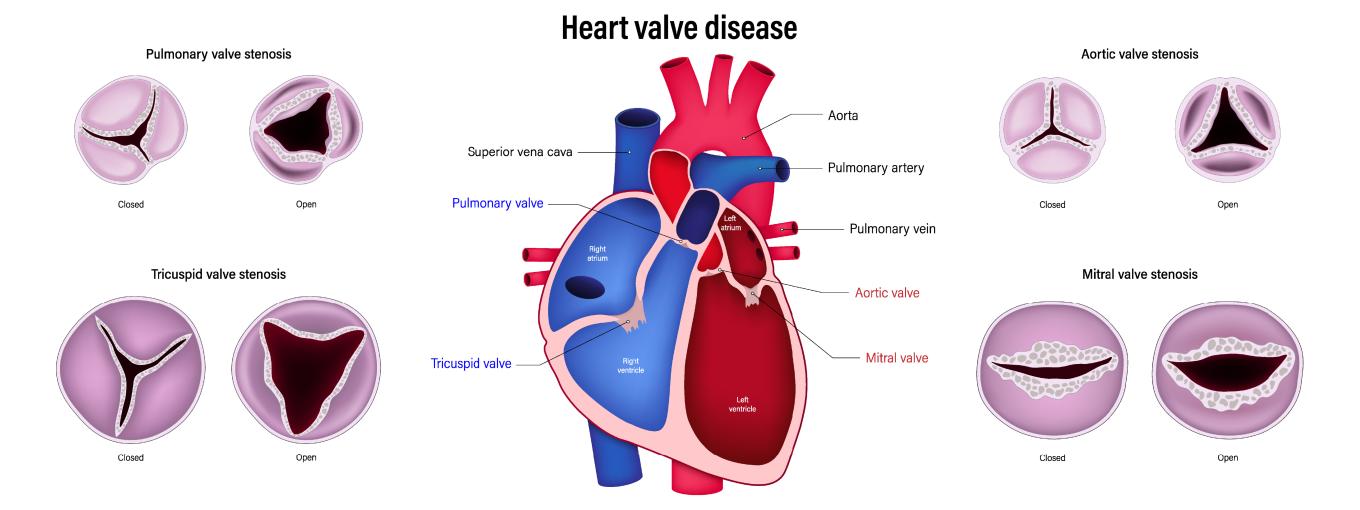
Types of Heart Valve Disease
The heart’s four valves are:
- Aortic valve: directs blood flow from the left ventricle to the aorta and sending blood to rest of body
- Mitral valve: directs blood flow from the left atrium and left ventricle
- Tricuspid valve: directs blood flow from the right atrium to right ventricle
- Pulmonary valve: directs blood flow from the right ventricle to the pulmonary artery for oxygenation
Signs of Heart Valve Disease
Heart valve disease, commonly in adults 60 years old and above, occurs when one or more of the heart valves don't work properly; either by leaking blood (regurgitation) or narrowing and restricting blood flow (stenosis).
It is possible to develop both regurgitation and stenosis, and possible for multiple heart valves to be affected simultaneously.
Signs and symptoms to watch for include:
- Heart Murmur
- Unusual Fatigue
- Shortness of breath, particularly when you have been active or when lying down
- Swelling of your legs, ankles, feet, abdomen and veins in the neck
- Dizziness
- Fainting
- Irregular heartbeat
Common Valve & Structural Diseases We Treat at HVI
Aortic Stenosis
A progressive disease in which aortic valve stiffens from calcium buildup, causing the heart to work harder. Treatment is replacing the valve either through open-heart surgery or minimally invasive transcatheter aortic valve replacement (TAVR).
Mitral Regurgitation
The mitral valve doesn’t close properly, causing blood to flow backwards. Treatment options include medication (for mild cases), transcatheter mitral valve repair in which a “clip” device is implanted, or open-heart surgery to repair or replace the mitral valve.
Tricuspid Regurgitation
The tricuspid valve doesn’t close properly, causing blood to back up in the heart’s right atrium. Treatment options are diuretic medication for mild cases, minimally invasive transcatheter tricuspid valve repair with a “clip” implant, or tricuspid open valve surgery for severe cases.
Congenital Heart Disease (CHD)/Pulmonary Valve Disease
One of the most common birth defects in the U.S., CHD usually involves the pulmonary valve either leaking or narrowing into adulthood. Treatment involves replacing the pulmonary valve with a minimally invasive transcatheter procedure or via open heart surgery.
Left Atrial Appendage Occlusion
Patients with atrial fibrillation (Afib) are at increased risk of blood clots forming in the left atrial appendage (LAA). For those who cannot tolerate blood thinners, LAA occlusion (also known as LAAO or a “watchman” procedure) is a minimally invasive transcatheter procedure that implants a closure device in the LAA to prevent clots from escaping.
Patent Foramen Ovale Closure and Atrial Septal Defects
This is a minimally invasive procedure that treats patent foramen ovale and atrial septal defects by inserting a catheter into the defect and a mesh closure device is expanded into place and closes the opening.
Hypertrophic Obstructive Cardiomyopathy (HOCM)
This condition is treated with alcohol septal ablation, a minimally invasive transcatheter procedure that injects alcohol into the septal artery to reduce the size of the thick heart muscle and improve blood flow.
Get Care Now
If you think you may have a heart problem, call your primary care provider. If you do not have a primary doctor and you are looking for heart care in Tulsa, call the Well Connected Hotline at 918-488-6688 to find a provider.
For general questions about Structural Heart at Saint Francis Heart and Vascular Institute, call the nurse coordinator at 918-494-6289.